Honest placebos: what sugar pills teach us about expectation
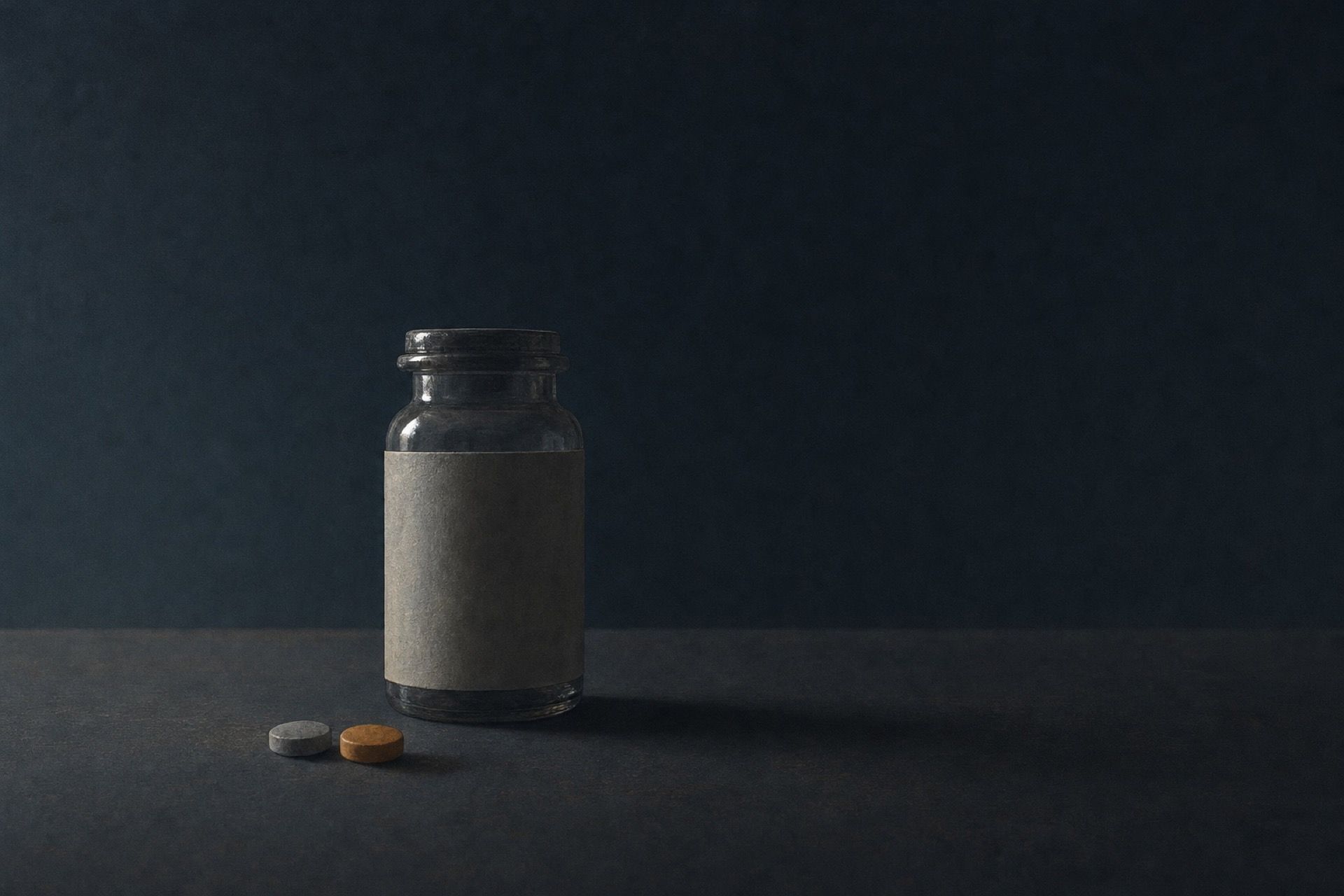
A doctor hands you a bottle of pills and tells you, with a straight face, exactly what is in it. The pills contain no drug. They are made of an inert substance, the kind of filler used in sugar pills, and you are to take two a day for three weeks. You do not need to believe they will work. You only need to take them.
That was the instruction given to people with irritable bowel syndrome in a 2010 trial led by Ted Kaptchuk at Harvard Medical School and Beth Israel Deaconess Medical Center. Most medical intuition says it should have produced nothing. A placebo is supposed to work because the patient thinks it is real medicine, and once the deception is gone, the effect should go with it.
It stayed. The people who knew they were taking sugar pills improved more than the people who took nothing, and later trials have repeated the result. Expectation and ritual change how people feel even when they know the full mechanism, and that finding should change how we think about any practice built on belief, self-hypnosis included.
The trial
The researchers recruited 80 adults with irritable bowel syndrome and split them at random into two groups. One group received the open-label placebo pills, described to them as inert pills that clinical studies had shown could produce improvement through mind-body self-healing processes. The other group received no pills. Both groups got the same amount of time and the same quality of attention from the clinicians, so the pills were the only difference.
Symptoms were measured at eleven days and again at three weeks. On both occasions, the placebo group reported significantly greater overall improvement, lower symptom severity and more adequate relief than the no-pill group. Quality of life also trended in the placebo group’s favour by the end. Kaptchuk later described the instruction the patients received: they did not have to believe in the placebo effect, only take the pills. The full paper, Placebos without Deception, appeared in PLoS ONE in December 2010.
Irritable bowel syndrome makes a good test case and a demanding one. Symptoms rise and fall from week to week, and the condition is known for strong placebo responses in ordinary drug trials, so researchers have plenty of experience measuring change in it. That same history means any single result needs repeating before anyone leans on it, which is what the team did next.
One detail in that design deserves attention. The patients heard an honest explanation, and the explanation was encouraging. They were told that placebos had helped people with their condition in earlier studies. Honesty and hope arrived together, and the trial tested the pair.
The replication
A single trial of 80 people invites doubt, so the same research group ran a larger one. Published in the journal PAIN in 2021, it split people with moderate to severe irritable bowel syndrome into three arms: an open-label placebo, a double-blind arm in which participants did not know whether they had placebo or peppermint oil, and a no-pill control.
About 30 percent of the participants in both placebo arms, open and hidden, reported a large drop in symptoms, compared with about 12 percent in the no-pill group. The honest placebo worked about as well as the hidden one. The researchers noted the implication directly: if deception is not required, many theories about how placebos work will need revising.
Researchers have since tested open-label placebos in chronic back pain and cancer-related fatigue, with encouraging early results. Most of these trials remain small, and the field is young, so the evidence so far says open-label placebos work for some symptoms in some people, under conditions researchers are still mapping.
What does the work
Scientists have studied the biology of the placebo response since 1978, when researchers in California found that naloxone, a drug that blocks the body’s opioid receptors, could cancel the pain relief people got from a placebo. That finding showed that placebo relief runs through the body’s own pain-control chemistry. Several ingredients appear to switch that system on. Expectation is the first: a person who expects relief prepares the brain to find it. Conditioning is the second: years of taking pills and feeling better teach the body an association between the act and the result. Ritual is the third: a fixed action repeated at fixed times, twice a day, in the same way. Care is the fourth: the time, attention and warmth of the clinician. In the open-label trials, the honest explanation carried the expectation, the pill bottle carried the ritual and conditioning, and the matched clinician time ensured that care alone could not explain the difference.
Expectation cuts both ways
The same machinery that produces relief can produce harm. Researchers call this the nocebo effect: a person who expects side effects tends to find them. In clinical trials, a share of the people taking dummy pills report headaches, fatigue and nausea, and the share rises when the consent form lists those symptoms in detail.
One of the clearest demonstrations came from a 2020 study in the New England Journal of Medicine. Sixty people who had stopped taking cholesterol-lowering statins because of side effects took a year of monthly bottles: four held a statin, four held a placebo, and four were empty. They recorded their symptoms every day. Most of the symptoms they felt on the statin also appeared on the placebo, and the researchers estimated that about 90 percent of the burden came from the act of taking a pill. Many participants restarted their statins after seeing their own data.
For anyone building a practice, the lesson is direct. Expectation is a working ingredient, and it works in whichever direction you point it. A person who starts a practice expecting nothing to change has already given the brain a prediction to confirm.
What a daily practice can borrow
Four features of the honest-placebo trials carry over to any daily practice, and none of them needs deception.
First comes an honest, encouraging explanation. The trial participants knew what they were taking and why it might help. Knowing the mechanism of a practice, and knowing that it has helped others, gives expectation something solid to rest on.
Second comes a fixed ritual, performed at the same time and in the same order each day. Repetition builds the conditioned link that makes the act itself a cue for change.
Third, the practice needs a long enough run. The IBS trials lasted three and six weeks, and the effects built over that time. A single dose tells you little.
Fourth, and easy to forget, is attention to change. The statin participants restarted their medication after they saw their own symptom records. A record of how you felt last week, set beside how you feel now, turns a vague impression into evidence you can trust.
Where the evidence stops
Placebo effects show up most clearly in symptoms people experience and report, such as pain, fatigue, nausea and gut discomfort. Conditions that need medical treatment still need it. Irritable bowel syndrome is a diagnosis for a doctor to make, and anyone with ongoing gut symptoms should see one.
Kizeyra is a wellness product. We make no claim that a session treats irritable bowel syndrome or any other condition. We cite these trials because they answer a question about the mind, and the answer is useful well beyond the clinic.
Why this matters for self-hypnosis
Self-hypnosis is open-label by design. You know the voice in your ears is a recording made for you. You know the method: focused attention, suggestion and rehearsal. Many people assume that knowing the mechanism should spoil the effect, the way learning a magic trick spoils the magic. The honest-placebo trials point the other way. Knowledge and benefit can sit together, and a clear, encouraging explanation can add to expectation.
Ritual is the other half of the lesson. The participants in the IBS trials took their pills at the same times every day for weeks, and the repetition built the conditioned link between the act and the relief. A daily practice works on the same principle. Kizeyra starts every session with one check-in question about your goal, at a time you choose, in a voice you chose, and that sequence becomes a cue the body learns to recognise. The fourth lesson, attention to change, is the reason the app asks how you feel about your goal before each session and plots those answers over time. Two weeks of answers, side by side, show you whether something has moved, and that record gives your next session an honest expectation to build on. We explain why expectation shapes perception in does the double-slit experiment prove your mind shapes reality, and the brain-scan evidence for suggestion is in how hypnotic suggestion changes what you feel.
The label on the bottle told the truth, and the patients felt better anyway. The work happened in what they expected and in what they repeated, twice a day, for three weeks.
Our daily sessions ask for the same two things.